
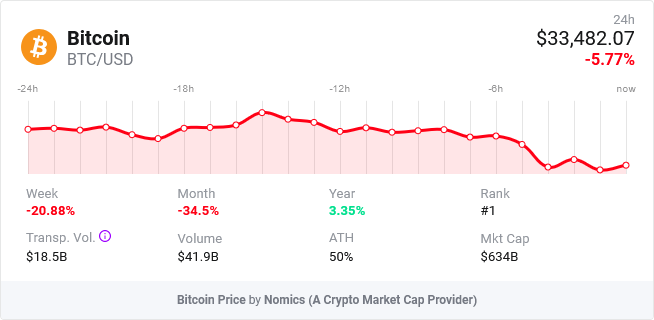
If you held Bitcoin through January 2022, you know exactly how this week felt. The coin that hit an all-time high near $69,000 on November 10, 2021 had crashed all the way down to the low $30,000s by late January, a drop of more than 50 percent from the peak in just under three months. The panic was real, and so was the temptation to sell everything and never look at a chart again.
But here is the thing about Bitcoin: the people who have been through a few of these cycles see something different in the chaos. One of them is Michael Bucella, general partner at BlockTower Capital, one of the better known crypto investment firms. His message, delivered on CNBC at the height of the selloff, was calm and almost counterintuitive: the continuous Bitcoin volatility should not come as a surprise, because it is part of the asset’s development trajectory.
🎙️ What BlockTower Is Saying
Bucella told CNBC that while Bitcoin is still a new asset class that is still growing, the future picture is still bright. He did not mince words about the recent price action either. According to Bucella, the price drop of Bitcoin below $35,000 is also a chance for ordinary investors to re-enter the market, which is a striking thing to say at a moment when most headlines were screaming about capitulation.
This is his reasoning, in his own words, and it is worth reading carefully:
Bitcoin is still firmly in growth mode, and if you look at a logarithmic chart, it’s still a long term bull trend. It’s still a young asset class, this is not all too surprising volatility, and Bitcoin and Ether were structurally low and declining over the last year
📉 A Painful Few Months
Let us put the decline into perspective. The asset’s slide began in the previous two months, when it fell below the $40,000 threshold after months of trading in the $50,000 to $60,000 range. At press time, the top-ranked cryptocurrency was trading at $33,600, down more than 6 percent in the past 24 hours alone. For anyone who bought anywhere near the November peak, the pain was deep.
But this is not the first time Bitcoin has done this. During the same 2021 that everyone now remembers as a great bull year, Bitcoin fell from around $64,000 in April to roughly $30,000 in July, a nearly 50 percent correction, and then went on to set a new all-time high a few months later. The pattern of violent drawdowns inside a long-term uptrend is not a bug in Bitcoin; it is a feature that has repeated itself in every cycle since 2013.
📊 Why the Log Chart Matters
Bucella mentioned a logarithmic chart, and if that phrase made your eyes glaze over, let me translate it. A regular chart shows price in absolute dollars, which makes small moves look tiny and giant moves look enormous. A log chart shows percentage changes instead, which means a move from $10,000 to $20,000 looks exactly as big as a move from $40,000 to $80,000.
Seen that way, Bitcoin’s long-term trend is still clearly upward, and a pullback from $69,000 to $33,000 looks far less apocalyptic. That is why long-term investors love log charts: they keep the noise of price levels from hiding the signal of the trend. Similarly, Bucella has urged investors not to be concerned about the market’s current volatility, stating that the digital currency would continue to rise rapidly in the future.
⚠️ The Other Side: Invesco’s Bubble Warning
Of course, not everyone is buying the bullish narrative. Historically, the high volatility of Bitcoin has enticed investors to participate, but according to Invesco, one of the world’s largest asset managers, that same volatility will now deter traders from doing so. As a result, the investing juggernaut predicts that the Bitcoin bubble will break in 2022.
It is worth taking both views seriously instead of just cheering for the one you want to be true. Bucella argues from the growth curve of a young asset class; Invesco argues from the froth of an overheated one. They can even both be right at different moments. The honest answer is that nobody knows, which is exactly why you should never bet more than you can afford to lose.
🧠 Final Thoughts
I have watched Bitcoin crash more times than I can count, and every single time, someone with a platform has declared it dead. And yet here we are. The bulls point at the log chart and the fundamentally sound narrative; the bears point at the froth and the bubble warnings, and both sides have real arguments.
What I take from the BlockTower call is simpler: dip buying and dollar-cost averaging are how long-term holders were born, and every legendary entry story started with a scary red chart like this one. Do your own research, ignore the noise when you can, and remember that volatility is the price of admission in this asset class. Thanks for reading.